
Vercel
Frontend cloud platform with edge deploys, Fluid Compute, and AI SDK, free Hobby plan and Pro $20/mo per member.
Description
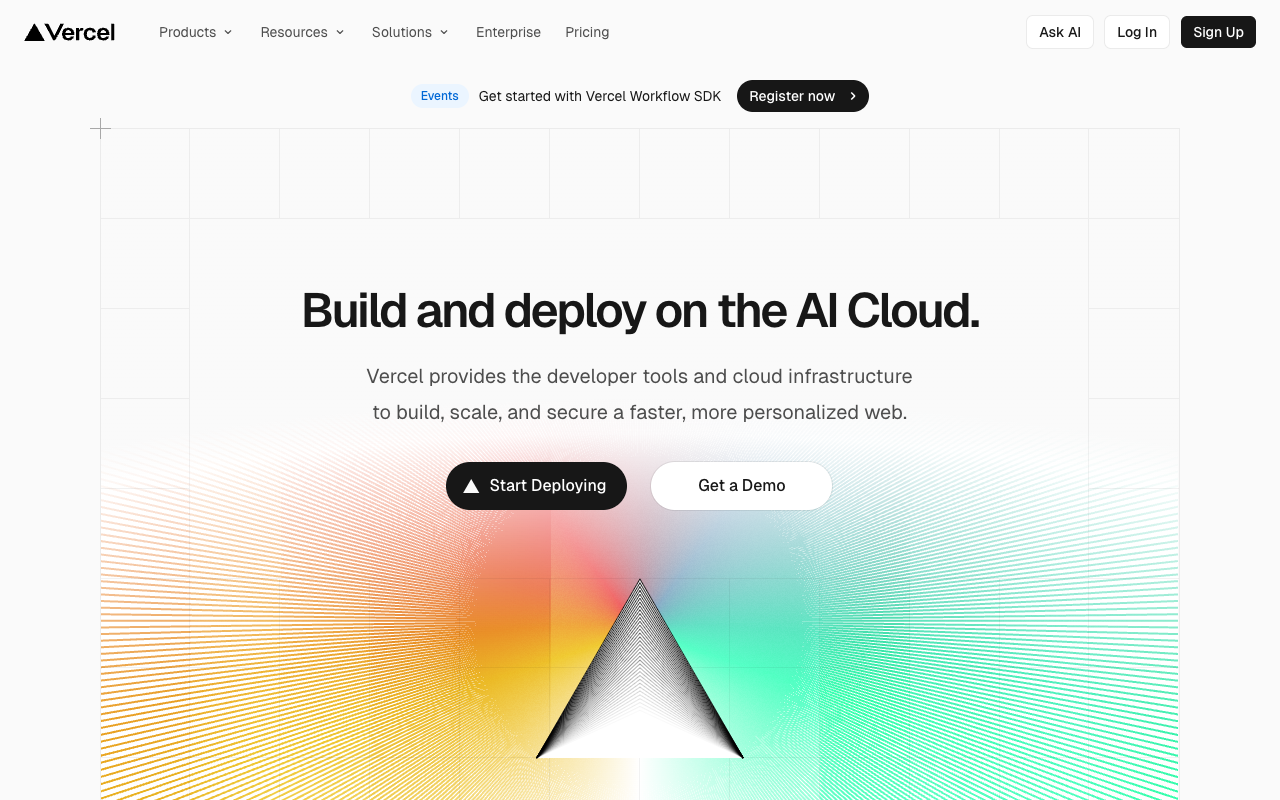
Vercel is the hosting and deployment platform created by the Next.js team that in 2026 has become the default destination for any app generated with v0, Bolt, Lovable, or Claude Code. It offers automatic CI/CD from Git, previews per PR, global CDN, Edge Functions, Fluid Compute (on-demand execution billed only for active CPU), and an AI ecosystem that includes AI SDK, AI Gateway, and v0 to generate UI from prompts. The Hobby plan is free for personal projects with 1M invocations and 4 hours of Active CPU per month; the Pro plan costs $20/mo per member with $20 of usage credit included; and Enterprise adds SSO, 99.99% SLA, managed WAF, and multi-region failover. It's the natural choice for modern frontend with React, Next.js, Astro, or SvelteKit.
Preview
Detailed Evaluation
Key strengths
Deploy literally on push
Connect a repo and every push to main goes to production, every PR gets a preview with a unique URL, and rollbacks are instant.
Fluid Compute saves on bills
Functions only bill for active CPU, not time spent waiting on I/O, which cuts costs for IO-bound apps compared to classic serverless.
Global edge with zero config
CDN, WAF, DDoS mitigation, and image optimization work from the Hobby plan without touching DNS or rules.
Integrated AI SDK and AI Gateway
Vercel's AI SDK is the de facto standard for LLM apps in TypeScript, and AI Gateway lets you route between OpenAI, Anthropic, Google, and open source models with a single API.
v0 bundled in the ecosystem
The Pro plan integrates with v0 to generate React+Tailwind components from prompts and push them to the repo as real code.
Limitations to consider
Bills can scale fast
The $20 Pro credit can disappear quickly if a landing goes viral or you ship unoptimized images; set hard spend limits.
Bias toward Next.js
The whole ecosystem is built around Next.js and other frameworks get second-tier support, which can push you into tech lock-in.
Not a full backend
Without a native database or auth, you need to combine it with Supabase, Neon, or similar to have a real product.
Hobby plan restrictions
Limited commercial use, tight caps, and some premium features locked force you to upgrade to Pro as soon as the project starts generating revenue.
Standout Feature
The unique 2026 combination of Next.js + v0 + AI SDK + AI Gateway means you can go from prompt to global deploy with integrated AI without switching tools, something no competing host reproduces at the same level of cohesion.
Comparison with Alternatives
Versus Netlify it offers better native Next.js support and more mature AI tooling; versus Cloudflare Pages it wins on DX and ecosystem but loses on price and unified runtime; versus Render or Railway it's much better for edge and frontend but worse for long-running backends.
Ideal User
Frontend and full-stack TypeScript developers living in the React/Next.js ecosystem who prioritize iteration speed and global deployment, and who are willing to pay for premium DX once the project is no longer a side project.
Learning Curve
Deploying is trivial, the CLI is consistent, and the dashboard is very clear. Complexity appears when optimizing Fluid Compute, understanding when to use Edge vs Node, or managing usage budgets to avoid billing surprises.
Best For
- Next.js projects that want to leverage ISR, Server Components, and Middleware at the edge
- Automatic deploys of apps generated with v0, Lovable, or Bolt from GitHub
- Teams that need per-PR previews and instant rollbacks
- Apps with AI features using AI SDK and AI Gateway to talk to multiple models
- Landings and portfolios that require global edge performance without configuring infra
Not Ideal For
- Long-running monolithic backends or workloads with long-duration processes
- Budget-constrained projects that consume heavy bandwidth or Active CPU
- Cases that need persistent WebSockets or intensive cron tasks outside its model