
Supabase
Open source PostgreSQL backend with auth, storage, realtime, and vectors on a Pro plan from $25/mo.
Description
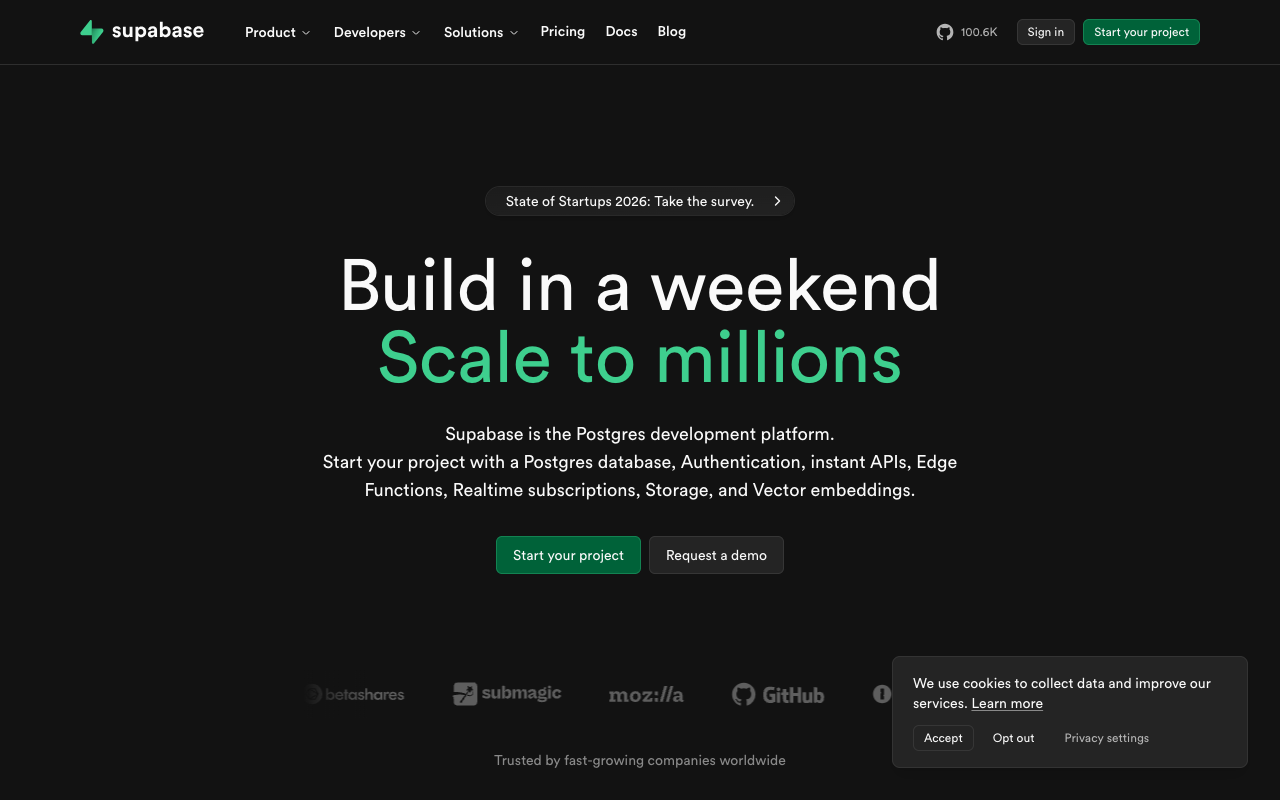
Supabase is the open source Firebase alternative built on PostgreSQL that in 2026 has cemented itself as the default backend for vibe coders working with Lovable, Bolt, v0, or Claude Code. It offers a relational database, authentication, Row Level Security, Storage, Edge Functions in Deno, realtime, queues, and vector embeddings for AI, all behind auto-generated REST and GraphQL APIs. Its native integration with the main app builders means a prompt can generate schema, RLS policies, and a typed client with no manual setup. The Free plan includes 2 active projects, 500 MB of database, 1 GB of Storage, and 50,000 MAU, while Pro ($25/mo) bumps it to 8 GB of database, 100 GB of Storage, 100,000 MAU, and removes the inactivity pause. It's ideal when you need real data control, portability to any Postgres, and the option to self-host the whole stack.
Preview
Detailed Evaluation
Key strengths
Real PostgreSQL, not an abstraction
You get a full Postgres with extensions, triggers, functions, and pgvector, which avoids vendor lock-in and lets you migrate to any managed Postgres.
Native integration with app builders
Lovable, Bolt, and v0 create tables, RLS policies, and typed clients from the prompt, connecting the project with a couple of clicks.
Full suite on a single platform
Database, Auth with OAuth, S3-compatible Storage, Edge Functions in Deno, Realtime, and queues (pgmq) under the same project.
Free plan usable for MVPs
2 active projects, 500 MB of database, 1 GB of Storage, and 50,000 MAU are enough to launch side projects and validate ideas.
Built-in AI tools
Native pgvector, Supabase AI in the dashboard for SQL and RLS policies, and an official MCP server for Claude Code and Cursor.
Limitations to consider
Free projects pause on inactivity
After 7 days with no requests, Free projects are paused, which is inconvenient for occasional demos or rarely-visited portfolios.
Writing RLS policies takes thought
Real security lives in Row Level Security policies, and writing them wrong is the main cause of leaks in AI-generated projects.
Self-hosting isn't plug-and-play
Running a full Supabase stack with Docker is possible but requires maintaining Postgres, Kong, GoTrue, Realtime, and Storage on your own.
Egress and Storage costs can scale
Apps with heavy multimedia content can see bills grow fast due to egress beyond included quotas.
Standout Feature
Being the only serverless backend whose integration with the leading 2026 app builders (Lovable, Bolt, v0) is native and bidirectional, generating tables, RLS, types, and a connected client from a prompt without giving up a standard Postgres you can move anywhere.
Comparison with Alternatives
Versus Firebase, Supabase offers real SQL, relations, RLS, and full portability with no vendor lock-in; versus Neon or PlanetScale, it adds integrated Auth, Storage, Realtime, and Edge Functions; versus setting up Postgres manually on Railway or Render, it saves weeks of plumbing on auth, storage, and APIs.
Ideal User
Vibe coders and small teams building with Lovable, Bolt, v0, or Next.js who want a serious backend without setting up infrastructure. Especially good when the project may grow and it's worth leaning on standard Postgres rather than a proprietary BaaS.
Learning Curve
Getting started is trivial thanks to the SDK and dashboard, but mastering Row Level Security, triggers, storage policies, and Edge Functions takes some time. The built-in AI assistants help generate SQL and policies, though you should review them before going to production.
Best For
- Projects generated with Lovable, Bolt, or v0 that need integrated database, auth, and storage
- Full-stack apps with Next.js, Expo, or SvelteKit that want managed, typed PostgreSQL
- Teams that need authentication, OAuth, and Row Level Security without writing a backend
- Apps with semantic search or RAG using pgvector on Postgres
- Startups that want portability and a real option to self-host later
Not Ideal For
- Projects that prefer NoSQL document-store databases
- Teams with no SQL or relational experience
- Use cases requiring sub-50ms global latency in every region