
Render
Full-stack PaaS with web services, cron, workers, and managed Postgres; free Hobby plan and Pro $19/mo.
Description
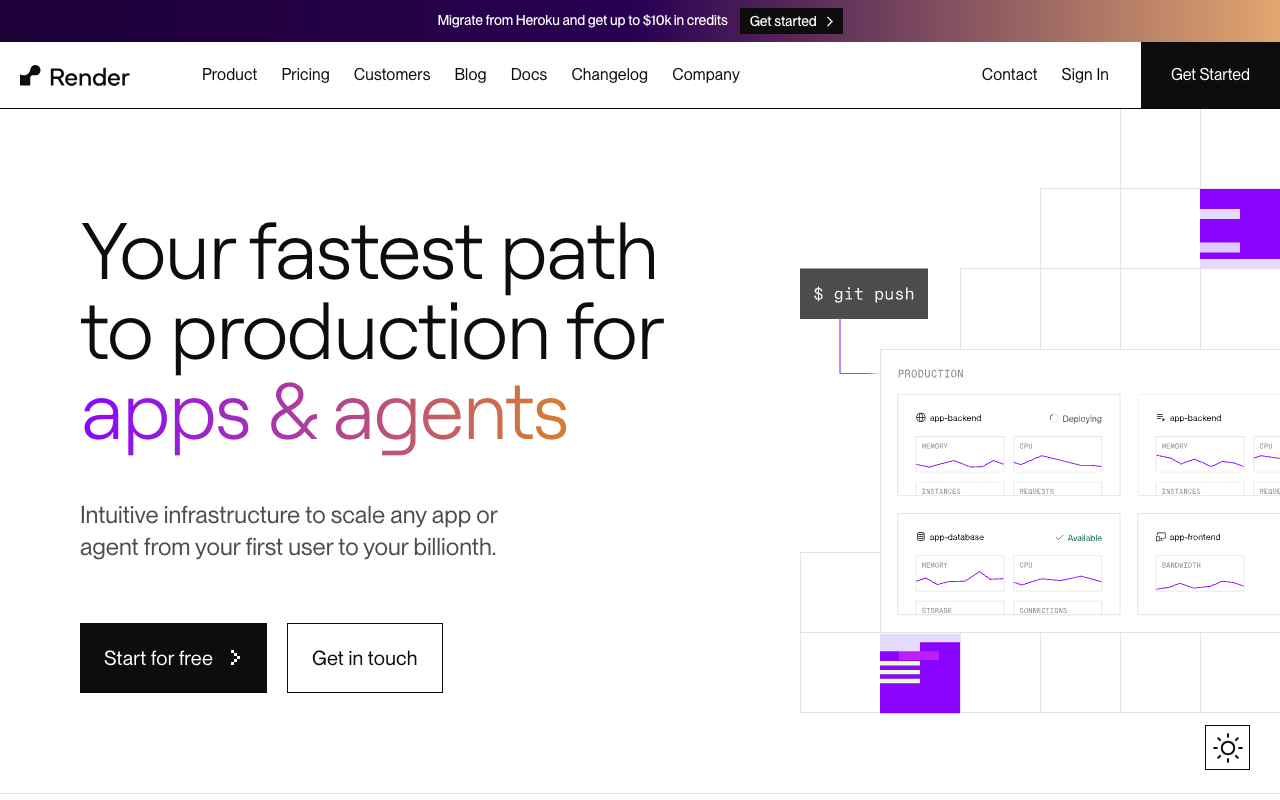
Render is the unified cloud platform that in 2026 competes head-to-head with Railway to host backends, databases, and static sites in one place. It offers web services, background workers, cron jobs, static sites, Redis, and managed PostgreSQL, with automatic deployments from Git, free TLS certificates, per-PR previews, and configurable horizontal scaling. The Hobby plan is free and includes 1 project with 2 environments, a global CDN, and web services that sleep after inactivity; Professional $19/user/mo adds 500 GB of bandwidth, up to 10 members, chat support, and preview environments; Organization $29/user/mo bumps to 1 TB, unlimited members, and SOC 2 Type II and ISO 27001 certifications; Enterprise offers SSO SAML, SCIM, guaranteed uptime, and dedicated support. Managed Postgres databases range from free to Pro instances up to $6,200/mo with PITR.
Preview
Detailed Evaluation
Key advantages
Complete all-in-one PaaS
Web services, workers, cron, Postgres, Redis, and static sites live in the same dashboard with a single bill.
Truly free Hobby plan
Unlike Railway, Render keeps a usable free tier for demos and small APIs, though with sleep after inactivity.
Serious managed Postgres
Paid instances offer PITR, logical backups, logs, and scaling up to thousands of dollars monthly for demanding workloads.
Blueprint (render.yaml)
Lets you declare all infrastructure as code in a single file and reproduce it across environments, useful for serious CI/CD.
Per-PR previews
Every PR spins up a full environment connected to an ephemeral database, on par with the best modern PaaS.
Limitations to consider
Free tier with sleep
Free web services sleep after inactivity, causing high latency on the first hit; awkward for live demos.
Less visual UX than Railway
Render bets on forms and Blueprint instead of Railway's graphical canvas; some users find it less modern.
Per-user pricing on team plans
The 'per member' model can drive up costs on large teams compared to Railway.
Smaller integration ecosystem
It has fewer templates, add-ons, and community than older platforms like Heroku or Railway's pace.
Standout Feature
Being one of the few PaaS in 2026 that offers web services, workers, cron jobs, serious managed Postgres, and static sites in a single product with a real free tier, combining it with Blueprint IaC for reproducibility.
Comparison with Alternatives
Against Railway it keeps a free tier but loses on visual UX and previews; against Heroku it's cheaper, more modern, and with better databases; against Fly.io it's simpler but less flexible on networking and multi-region deployments.
Ideal User
Developers and startups looking for a modern Heroku to host API, database, workers, and static site in one place, who prefer to declare infra as code and value a real free tier to prototype before paying.
Learning Curve
Creating a service from a repo is straightforward and the dashboard is clear. Depth shows up when using Blueprint, configuring autoscaling, setting up private networks between services, and managing large Postgres databases.
Best For
- Node, Python, Go, or Rails backends that need persistent services
- Projects with managed Postgres, backups, and PITR without running RDS
- Applications with 24/7 cron jobs and background workers
- Static sites with global CDN and automatic TLS certificates
- Teams coming from Heroku looking for a modern replacement
Not Ideal For
- Pure frontend apps where Vercel or Netlify lead on DX
- Users who want to see their infra as a visual canvas (Railway is better)
- Cases that require multi-region edge with sub-100ms global latency