
Railway
Visual PaaS with zero-config deployment for apps, databases, and microservices from $5/mo.
Description
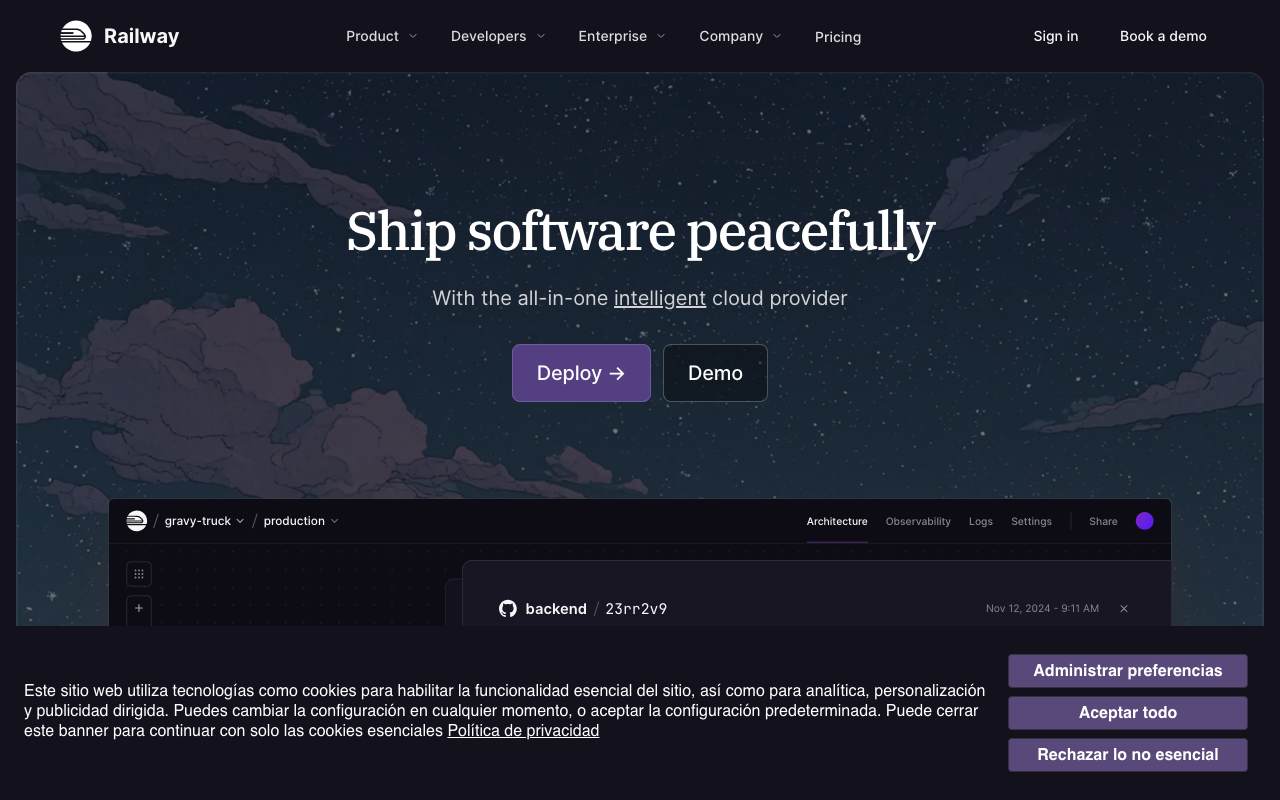
Railway is the PaaS platform that in 2026 has become the refuge of vibe coders who need more than just an edge frontend: Node, Python, or Go backends, Postgres or Redis databases, workers, queues, and cron jobs, all on a visual canvas where each service is a box and connections are lines. It auto-detects languages and frameworks via Nixpacks, deploys from GitHub or a Dockerfile, and offers per-branch preview environments and project-wide shared variables. The Hobby plan costs $5/mo with $5 of usage credit included, Pro is $20/mo with $20 of credit and scaling up to 1,000 vCPU per service, and Enterprise adds SSO, HIPAA BAA, and dedicated support. It's the best choice when you need a real backend alongside your Vercel frontend.
Preview
Detailed Evaluation
Key advantages
Truly zero-config
Nixpacks detects your language, installs dependencies, and launches the service without a Dockerfile; works for 90% of common stacks.
Unique visual canvas
You see every service, database, and volume as a graph and connect them by dragging variables, an approach no competitor replicates as well.
One-click managed databases
Add Postgres, MySQL, Redis, or MongoDB from templates, with backups, metrics, and credentials injected automatically.
Real per-branch previews
Every PR spins up a full environment with an ephemeral database, ideal for product demos and QA.
Predictable pricing with hard limits
The included credit covers small apps and configurable spend limits prevent surprise bills.
Limitations to consider
No more permanent free plan
Railway retired the free tier a while ago: the real minimum is $5/mo, which rules out purely hobby projects with no budget.
Fewer regions than hyperscalers
Available regions are limited and multi-region routing only exists on higher plans.
Cost optimization takes practice
Understanding what a replica, a Postgres, and a worker cost per month forces you to watch metrics and tune resources.
Limited human support on Hobby
Direct team support only appears on Pro and Enterprise; on Hobby you rely on Discord and documentation.
Standout Feature
The visual infrastructure canvas with automatic stack detection: you can go from an empty repo to a Node app with Postgres, Redis, and worker deployed in five minutes, seeing everything as a live diagram.
Comparison with Alternatives
Against Render it has better visual UX and more powerful previews; against Fly.io it's much simpler but less flexible on networking; against Heroku it recovers the good parts (zero-config, add-ons) with modern pricing where you only pay for actual usage.
Ideal User
Full-stack developers who need a real backend (API, workers, database) and hate writing YAML, Kubernetes, or AWS configs. Especially strong for anyone who already has their frontend on Vercel and wants to move the backend off serverless without setting up DevOps.
Learning Curve
Deploying a service takes three clicks and the documentation is solid. The curve shows up when you want to understand consumption, tune replicas, or build architectures with multiple connected services and private networks.
Best For
- Node, Python, Go, or Rust backends that need a managed database alongside
- Teams that want to see their infrastructure as a diagram instead of YAML
- Projects with workers, queues, cron jobs, or persistent WebSockets
- Hosting microservices and staging Postgres with per-branch previews
- Vibe coders migrating from Heroku or looking for Fly.io with less config
Not Ideal For
- Projects that only need a static landing page (Vercel/Netlify are better)
- Workloads with massive unpredictable spikes that would blow up pay-as-you-go
- Teams that need fine-grained kernel control, dedicated GPUs, or specific regions